After a recent office hours with Fabri, I explored several ideas for an interactive project. Two initial concepts stood out:
- A character with emotional reactions – This idea involves a small box with a square LED screen on top, along with a knob and a button. Inside the LED screen, a small character reacts to user input: rotating the knob makes the character turn and become angry, while pressing the button “feeds” it, making it happy.
- A chaotic movement challenge – Inspired by a piece showcased at the Winter Show, this concept features a small dot and a target box on an LED screen. Players use four buttons (up, down, left, right) to control the dot, but the controls are deliberately counterintuitive, introducing noise and unexpected movements that make guiding the dot into the box a challenge.
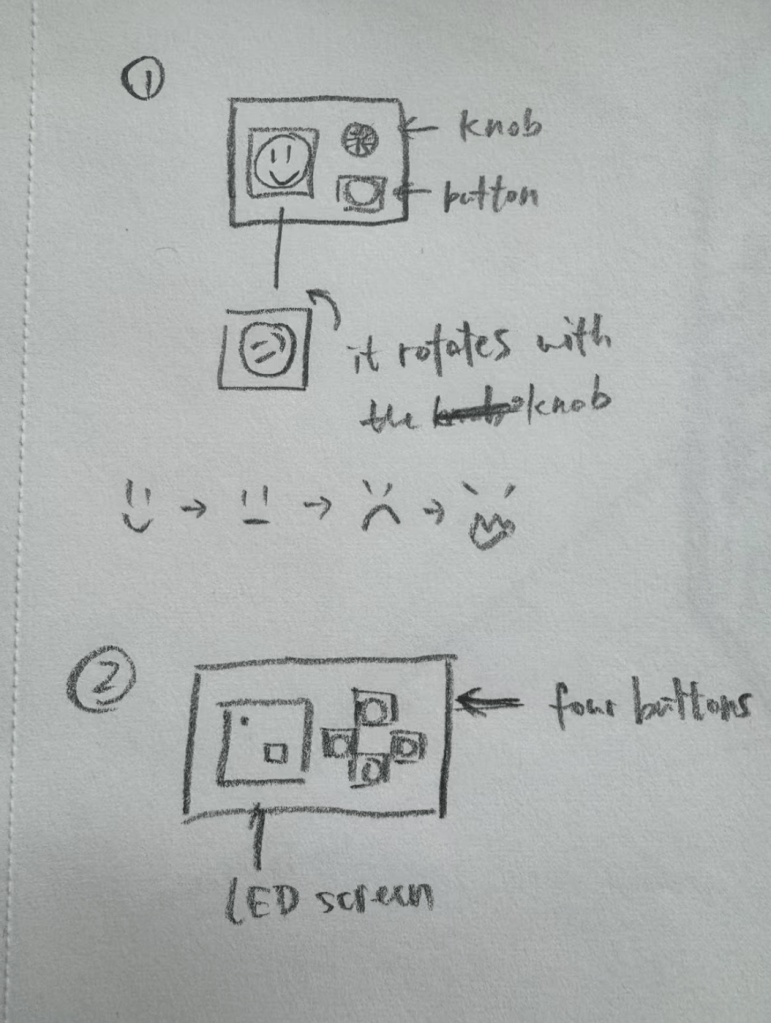
And after refining these ideas, I decided to move forward with the second one but with a twist: instead of a purely digital implementation in p5.js, I wanted to create a more tangible experience. To achieve this, I ordered an LED matrix to serve as the display for the game.
Prototyping in p5.js
While waiting for the LED matrix to arrive, I built a digital prototype in p5.js to test how the interaction would work. The goal was to fine-tune the movement mechanics and explore how challenging (or frustrating) the controls should be to create an engaging experience. Here’s a preview of the effect in action:
Here is the link toward p5.js: https://editor.p5js.org/xc2736/sketches/elosDLYjL
 Anna Chen Blog Post
Leave a comment