When people have wealth and resources that do not match their capabilities, those resources do not lead to innovation and revolution, but only to more suffering and conflict. Congo is a very good example. About a quarter of the tantalum ore mined in the first decade of the twenty-first century came from Congolese coltan. Coltan, short for coltan, is an unrefined mixture of two metallic ores from which tantalum can be extracted. Tantalum is an excellent conductor of electricity and is mainly used in the miniature capacitors that make our increasingly miniaturized electronic devices work. The huge profits have made an already troubled country even more chaotic and disorganized, and forty percent of the mining workforce are children (about six years old). And like other miners, many of them have been exposed to mercury, uranium and other heavy metals. What most of us don’t realize is that the elements of the electronic devices we use in our hands contain such a bloody story and history. For all the talk about Web 3.0 and decentralization, are we just dressing up the same old systems? Even with blockchain or decentralized networks, the question remains as to who will benefit from it. Countless people are profiting from the growth of this industry, so how do we ensure that the system is free from graft or corruption? Although a lot of things are now data-driven, behind this invisibility, it relies on a very large amount of physical infrastructure and manpower, with some areas and resources of manpower exchanged for our current society. While enjoying these technological conveniences, can we really realize the costs behind them? In the next historical process, how can we promote the development of AI technology while ensuring that we do not repeat the mistakes of the past?
Category: Creative Approaches Through Emerging Media
-
Class 10 | Internet History and John Perry Barlow’s “A Declaration of the Independence of Cyberspace”
After reading through the article ”A Declaration of the Independence of Cyberspace” by John Perry Barlow, I immediately connected with the situation and relationship we encounter with generative AI right now. What John said in this declaration was indeed hopeful and pleasant, but it was way too idealistic. It’s true that at the early age of cyberspace, it was not under the control of the government, where people had the authority to govern their own. But without supervision and regulation, in the state of anarchy, people’s rights would not be granted but be deprived. Similar things are happening today. Artists’ rights are not guaranteed at all; their artwork can be easily copied and duplicated by AI, and I think it’s really important for people to regulate it. But still, I think there are some points he mentioned worth pondering, especially the part where he mentioned how cyberspace fosters a global conversation that transcends geographical boundaries. This infrastructure allows for a diverse range of voices and ideas, promoting cultural exchange. -
Class 7 | Visting Bitforms Gallery
Last weekend, I visited Bitforms gallery to see Rafael Lozano-Hemmer’s limited-time exhibition, Caressing the Circle. Running from September 4 to October 26, I wanted to ensure I saw his works before the exhibition concluded. The small gallery space featured only five pieces, but each left a deep impression. The walls were painted pure white, creating a sharp contrast between the works and their environment. I came to this gallery because I’ve always been intrigued by how Lozano-Hemmer blends technology with human interaction in his new media art. The experience didn’t disappoint.
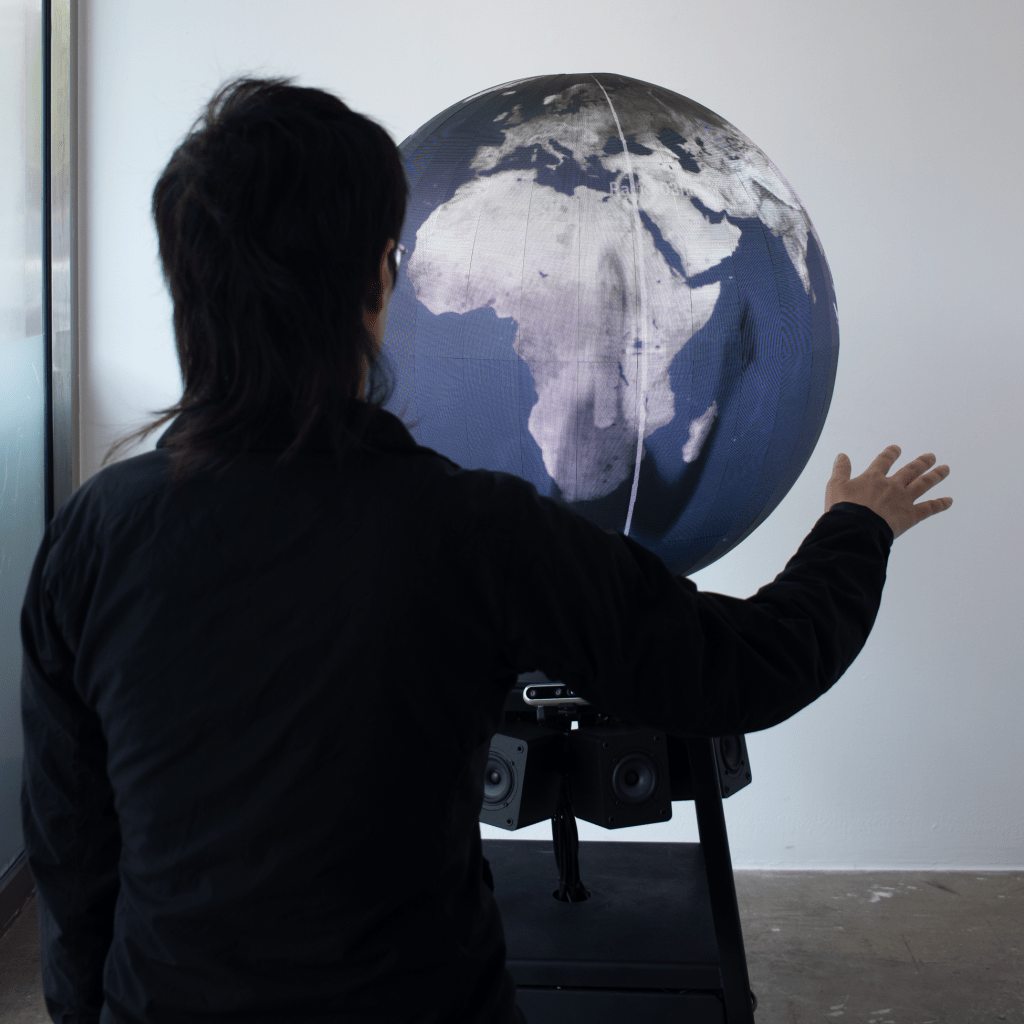
Shadow Tuner
2023The first thing that caught my eye as I entered the gallery was Shadow Tuner (2023), a large spherical LED display. This interactive piece stood 67 inches tall, resembling a giant globe, with cameras and speakers mounted around its base. As I moved in front of the globe, I could listen to live broadcasts worldwide. The built-in AI analyzer prioritized spoken word content, and when I spoke in Chinese, I was immediately tuned into a Chinese broadcast stream. With the different languages playing in the background, I continued further into the gallery.
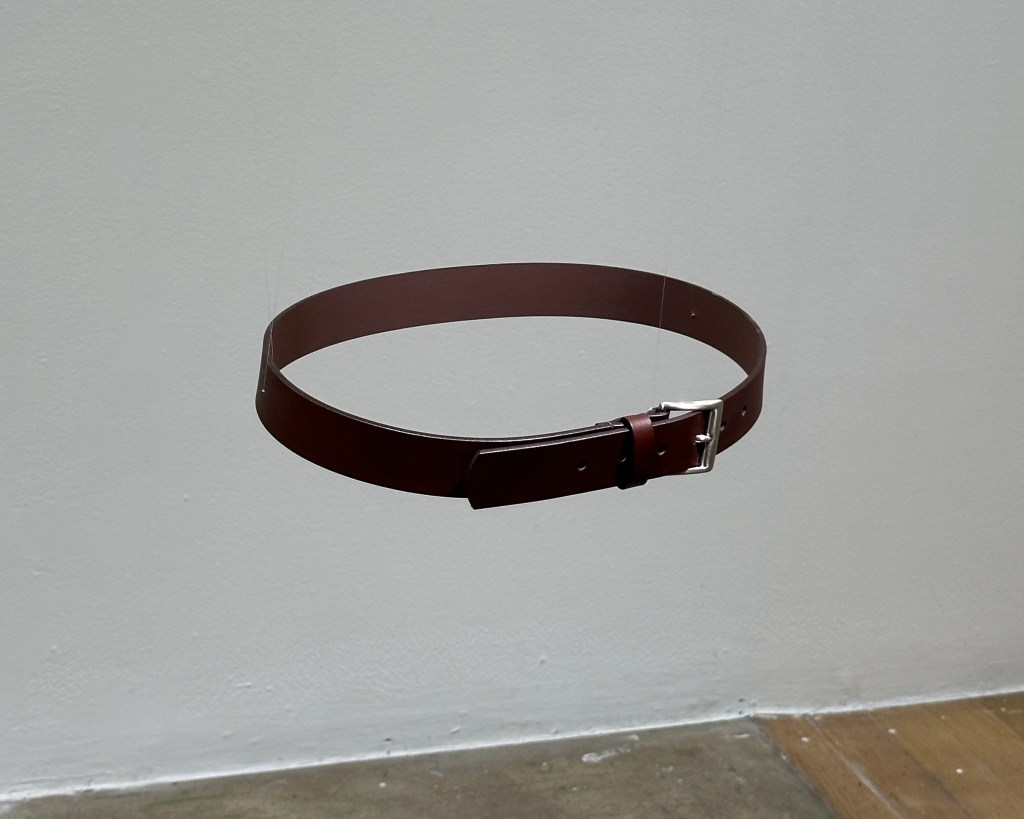
Standards and Double Standards: Single Belt Version
2004The next piece that caught my attention was Standards and Double Standards: Single Belt Version (2004). This work consists of a leather belt suspended from the ceiling, and as I moved around the room, it followed me, creating a subtle confrontation between me and the piece. The belt seemed to symbolize authority or control, making me reflect on themes of surveillance and power. Although the work was completely silent, its relentless, almost indifferent movement created an atmosphere of quiet tension. The absence of a human wearer emphasized the concept of invisible authority, evoking a feeling of being watched by something intangible yet ever-present. No matter where I went, as long as I was in view of the camera, I was always being tracked, and the belt’s buckle would “stare” right at me.
The piece that left the deepest impression on me was Transparency Display (2024), an interactive glass triptych made of custom liquid crystal panels. This work simultaneously reveals and obscures the portraits of viewers on both sides of the glass in real-time, creating a surreal sense of connection, as individuals are both spectators and participants, becoming part of the installation through their fleeting reflections. At first, I thought it was a mirror, but upon closer inspection, I realized it was transparent. Later, I looked up more details and found that the technology behind Transparency Display is extraordinary. It uses liquid crystal pixels that shift between transparency and translucency, allowing portraits to appear and disappear in a subtle, haunting way. This feature is far more advanced than standard smart glass technologies, as the panels display real-time content, offering a more immersive experience than simply switching opacity for privacy.
The atmosphere of the piece was ethereal. The soft lighting in the gallery enhanced the faint silhouettes appearing and disappearing on the glass, blurring the line between indoors and outdoors. Light, shadow, and human presence created a dynamic effect that connected both sides of the triptych, turning it into a living portal. What fascinated me most were the brief personal connections the piece facilitated—seeing a stranger across the glass in such an intimate yet eerie way, as though they were right there with me. The exhibition’s layout was crucial to my understanding of the work. Despite the gallery’s small size, positioning Transparency Display in the center, with a mirrored environment on both sides, heightened the illusion of looking at oneself through another’s eyes.
-
Class 4 | Evaluating New Media Art
In Bell Hooks’s article “Critical Thinking”, she walks us through how children’s critical thinking, or, to say, creativity, was suppressed as they grew. Personally, I think critical thinking is one of the ways of creative practice. To support this, then, what is creative practice, and what is critical thinking? To me, creativity is a given talent that all of us have, a personal and special taste in our daily lives. We can be creative in many ways; art is the most obvious and traditional means. We could be creative about what we eat; we could be creative about how to get to school, and we could also be creative about what to wear today. Creativity is a process that seeks our own opinions and thoughts. And critical thinking is just another matter of creativity that applies to academic or serious events. “By the time most students enter college classrooms, they have come to dread thinking”, Hooks says in her article. For those of the students, they’ve lost their passion for the school or for the things they have to learn. Since the school has all these principles and rules that they have to follow, they are being shaped into a mold that adults/people believe to be good. If you were a good student, would you come up randomly with a bold question in the middle of a lecture in front of hundreds of people to share your own opinion on a specific topic? I assume not since it’s rude and maybe unnecessary to give this a try. However, this is just an extreme example, you can still be critical thinking and creative and go ask your teacher privately or brainstorm on your own. But that’s what I understand as why it explains what Hooks said about students now being passive recipients of all information and no longer thinking critically.
-
Class 3 | New Media Art
In his book The Language of the New Media, Manovich says that the popular understanding of new media identifies it with the use of a computer for distribution and exhibition rather than production. For example, photographs on a display are considered new media, whereas those printed in a book are not. Manovich thinks it is too limiting to privilege the computer over other media. He thinks the fundamental difference between the new and old media is that the process of the old media tends to be continuous, while the new media can be both continuous and discrete. Since new media can often be edited digitally, the data that made up the new media art could be sampled, quantified, and discrete in various ways, which old media could never do.
Another difference between old and new media is that new media can be copied endlessly without degradation, while old media loses quality with each successive copy. Old media can also be converted into a numerical representation and turned into new media in a process called digitalization. However, this digitalization has a drawback: it causes a loss of information and usually contains a fixed amount of information.
Personally, I really like what he says at the end of the chapter, “interactive computer media perfectly fits this trend to externalize and objectify the mind’s operations.” The idea that brings the unobservable and interior processes of creating art to the public is what makes the new media charming. I think it’s because of this discrete characteristic of new media, which allows us to reassemble our mindedness process and place it outside. New media becomes a new language that help us to speak out the stuff that were never reveal in the past human history. I want to end this blog with another quote: “Mental processes of reflection, problem-solving, recall, and association are externalized, equated with following a link, moving to a new page, choosing a new image, or a new scene.” We are now entering into a new phase, where people are free to share their minds and story with no boundreis and limits.
-
Class 2 | Why Art?
After reading these two articles, the first thing that came to mind was that art should never be confined to specific categories or terminology. As Quaranta mentioned at the end of the chapter, “They want to be understood as art, not as New Media Art.” People often focus more on the mediums and materials used in media art rather than on the messages or stories behind the artworks. The fame of the label “media art” can overshadow the art itself. Diaz shared a similar perspective in her article “A Lexicon of the Indigenous Body: Images of Autonomy and Desire.” Regardless of how Western academics label their art—whether as folk art, primitive art, street art, outsider art, political art, or incendiary art—it does not alter its intrinsic value and beauty. However, these definitions can create biases.
I actually admire Diaz’s confidence in her culture and the art that has been a part of it for hundreds of years. My passion for art also began with a rather minor culture. I remember when I was in elementary school, my family had many Chinese picture books, which were quite different from comics; they were more like murals, with one image following another. I was particularly fascinated by the stories composed of these exquisite little images, which led me to fall in love with Japanese manga. What started as individual images evolved into something more continuous and narrative. This eventually led me to develop a love for anime. However, my enthusiasm was gradually dampened because many people did not consider these forms as true art, viewing them instead as commercial products with commercial value, and thus as vulgar art compared to traditional oil paintings and sculptures. As a child, I didn’t know how to counter this perspective and could only continue forward with disappointment and a sense of being misunderstood.
However, as I grew older, I realized that the medium does not determine the quality or value of art. In my understanding, as Diaz says, “lexicon does not mean the static system of symbols elicited and studied by Western-educated linguists and ethnographers for centuries.” This lexicon encompasses what people wish to express, transcending media, text, and written form. It can be embodied in physical movements, parts of the body, digital formats, or any medium you can imagine. Just like that urinal we talked about in the last class, as long as someone thinks he has meaning, no matter what anyone else thinks, know that for that person, that is art.
 Anna Chen Blog Post